For dental professionals●Authorized DSI® distributor
Dental Bone Graft Materials for Clinical Practice
Compare synthetic β-TCP + hydroxyapatite and bovine mineral collagen graft plugs for socket preservation and dental grafting procedures. Sterile 5-plug boxes, placed dry in one step — supplied to US practices from Lakewood, New Jersey.
Same plug, same carrier, same 10 × 20 mm format, same placement. The mineral inside the collagen is the entire difference — an alloplast in one, a xenograft in the other — and it is what decides how quickly the graft turns over.
Showing 16 of 16 properties
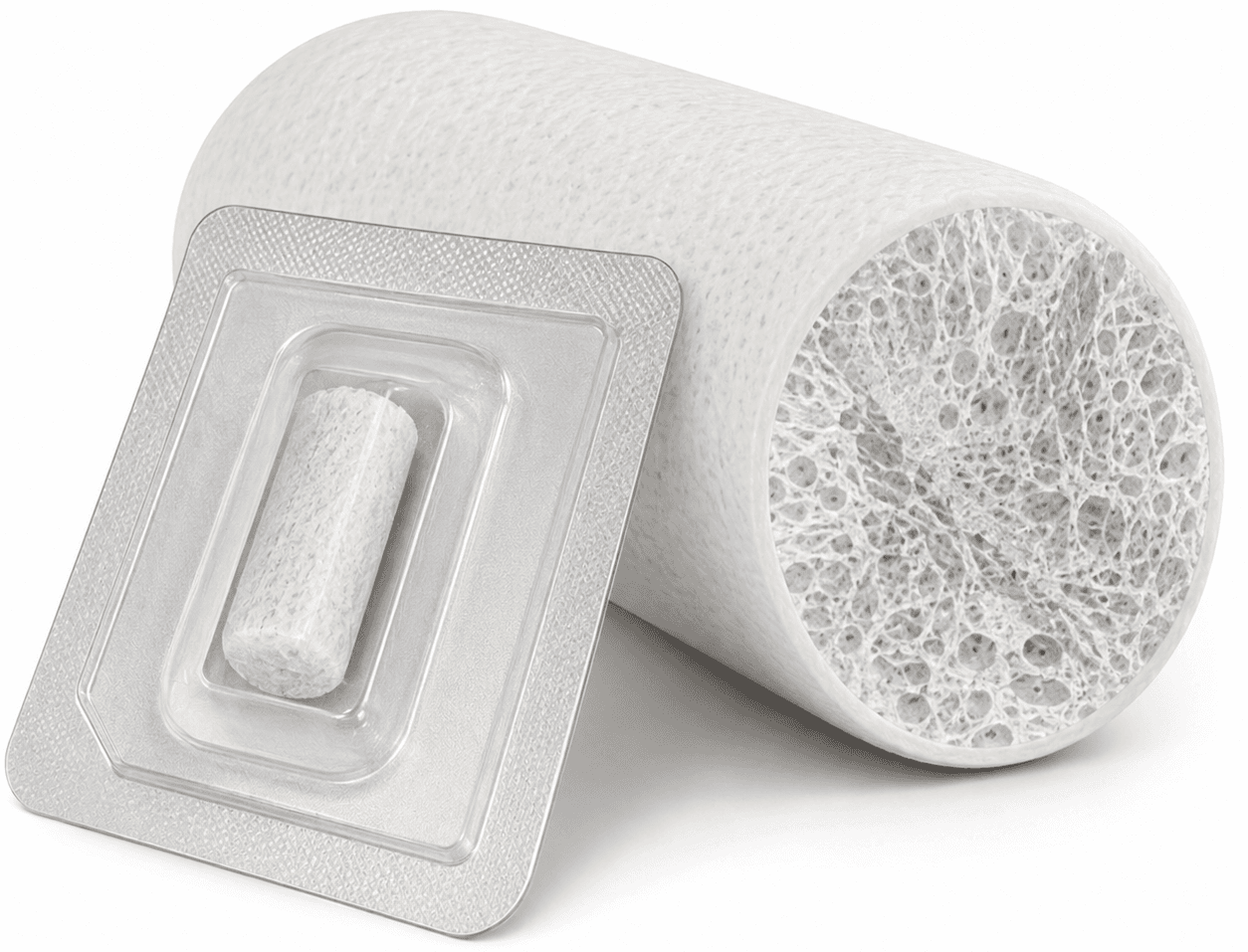
Side-by-side comparison of the SpongeGraft synthetic alloplast and Sponge ZenGraft bovine xenograft dental bone graft materials
Property
SpongeGraft· Synthetic
Sponge ZenGraft· Bovine
Material categoryDiffers
SpongeGraftAlloplast — synthetic bone graft material
Sponge ZenGraftXenograft — animal-derived bone graft material
Implanex supplies two dental bone graft materials in the same format: a preformed collagen plug carrying a bone mineral. They are placed identically. What differs is the mineral inside the collagen — a synthetic alloplast in one, a bovine xenograft in the other — and that is what drives the selection.
01The clinical objective
What the graft is being asked to do in this case — hold space in a contained socket, support ridge volume ahead of an implant, or fill a defect around one — frames every other decision below.
02Defect morphology and containment
Whether the walls are intact and the defect is contained determines both whether a plug format fits the site at all and whether a barrier membrane is still indicated alongside it.
03Desired resorption behaviour
Both minerals are osteoconductive scaffolds. They differ in how readily the mineral phase turns over, which is the single most common reason clinicians pick one class over the other.
04Volume-maintenance requirement
Where longer-term space maintenance is the priority, a slower-turning-over mineral is generally the one selected. Where the intent is quicker replacement by the patient’s own bone, the more soluble synthetic phase is generally preferred.
05Material-source considerations
Some patients decline bovine-derived material. Note that this narrows but does not resolve the choice here: the synthetic option refers to the mineral phase only, and both plugs use a bovine Type I collagen carrier.
06Practitioner judgement and inventory
Familiarity with a material, and whether a practice would rather standardise on one SKU than stock two, are legitimate inputs. Both products are supplied on identical bundle terms, so the commercial side does not force the clinical one.
Compare the material characteristics, review the resorption profiles, and select on the case in front of you. Nothing on this page is a treatment rule — the instructions for use in every box and your own clinical judgement govern.
The category
What dental bone graft materials do
A dental bone graft material is a scaffold, not a bone substitute in the literal sense. Placed into a defect or an extraction socket, it occupies and stabilises the space while the patient’s own biology does the regenerating along it.
01They are osteoconductive scaffolds
Both alloplast and xenograft materials work by osteoconduction: they provide a porous framework that the patient’s own bone-forming cells migrate into and lay new bone along. The material enables bone formation; it does not induce it. That distinction is why no graft material can promise a regenerative outcome.
02Scaffold properties decide how the site behaves
Porosity, particle architecture and the solubility of the mineral phase govern how long the scaffold holds its space and how much of it is still present months later. A more soluble phase turns over sooner; a less soluble one persists and keeps holding volume.
03Alloplast and xenograft are different categories
An alloplast is synthetically manufactured — here, a β-tricalcium phosphate and hydroxyapatite blend engineered to mimic the mineral phase of bone. A xenograft is bone mineral of animal origin, processed to remove cellular elements and leave the mineral matrix. Neither category has been established as clinically superior to the other for hard-tissue outcomes.
04Delivery format is an operational decision
The material class is a clinical choice; the format it arrives in is a workflow one. Loose particulate has to be mixed, packed and protected against washout. A preformed collagen plug carries the mineral into the site in a single step, which changes chair time rather than biology.
Product format
What a preformed collagen graft plug changes chairside
Six things that are true of both materials, and that loose particulate grafting does not give you.
Preformed, consistent dimensions
Every plug is the same 10 × 20 mm form, so what you open is what you expect. No scooping, no estimating a volume from a vial.
One-step placement
Open the sterile blister and deliver the plug dry into the bleeding site. Grafting and haemostasis happen in the same movement rather than as two separate steps.
No chairside mixing or rehydration
Nothing to hydrate, blend or wait on. That removes a preparation step from the visit and removes the variability that goes with it.
The collagen holds the mineral in place
The Type I collagen body form-fits the walls and keeps the mineral where it was placed through irrigation and closure, instead of leaving loose granules to migrate.
Sterile, individually packaged
Each of the 5 plugs in a box is sealed in its own sterile double blister. You open one plug per site, not a shared container.
Simpler inventory
Two references, one format, one placement technique. A practice can stock both material classes without stocking two different workflows.
A plug format changes handling, not clinical judgement. It does not remove the need to assess the site, and it does not replace a barrier membrane where one is indicated.
Clinical use
Where these dental graft materials are used
Three tiers, kept apart on purpose: what the manufacturer lists for these products, what the material classes are used for generally, and what the case decides.
Supported product indications
What DSI lists for these plugs
Extraction socket and ridge preservation
Periodontal defects
Defects around implants
Post-resection and cystectomy defects
Crest / ridge maintenance ahead of implant placement
As published by the manufacturer for the Sponge plug line. The instructions for use supplied in every box govern indications and contraindications and take precedence over this page.
General clinical applications
Where dental graft materials are used more broadly
Socket preservation at the time of extraction
Alveolar ridge preservation
Extraction-site grafting ahead of an implant
Guided bone regeneration alongside a barrier membrane
These describe the procedures the material classes are used in. They are not a claim that every one of them is an indication for these specific plugs, or that a plug format suits every one of them.
Case-dependent considerations
Where the case decides, not the product
Intact, contained sockets are the best fit for a preformed plug
A deficient wall or non-contained defect is a different case — barrier membrane and standard GBR principles still apply
Sizing, trimming, and whether more than one plug is used are clinical decisions
Not every extraction socket is an appropriate site for grafting
In intact, contained sockets these plugs are placed as a one-step procedure without a separate membrane. Read that as a description of the contained-socket case, never as a general rule.
Professional use. For use by licensed dental professionals only. This page is product information for a dental practice audience — not medical or clinical advice, not patient information, and not a substitute for the manufacturer’s instructions for use, which are included in every box and take precedence. Coding and reimbursement are decided by the payer and the case; we supply the material and make no representation about coverage. Always apply your own clinical judgement.
Decision support
How to choose between synthetic and bovine bone graft material
Written as considerations, not rules. The published evidence does not rank these two material classes against each other, so neither does this page.
Synthetic may be considered when
SpongeGraft · DS-SG1020 · alloplast
A synthetic mineral phase is preferred over an animal-derived one
The intent is for the mineral to turn over as the patient’s own bone forms along it
The case is a routine, contained extraction socket
A practice wants a single everyday material for the majority of its sockets
Per-box material cost is a consideration across a high extraction volume
The β-TCP / hydroxyapatite mineral is osteoconductive: it acts as a scaffold for the patient’s own bone to form along, with a balanced resorption profile from the more soluble β-TCP fraction and the slower hydroxyapatite fraction.
Bovine may be considered when
Sponge ZenGraft · DS-ZG1020 · xenograft
Longer-term space maintenance is the stated priority for the site
The plan calls for a slower-turning-over mineral at the graft site
The clinician’s protocol already favours a bovine mineral for this indication
The site is being prepared for an implant where ridge volume support matters most
Practitioner familiarity with the xenograft category is the deciding factor
Natural bovine bone mineral is osteoconductive: new bone forms along the scaffold rather than immediately replacing it. The mineral turns over more slowly than the synthetic option, which is why it is generally selected where longer-term volume support is the priority.
Neither column is a recommendation and neither material is presented as better. Published reviews of ridge-preservation materials have not established that any one material class is clinically superior for hard-tissue outcomes — so discuss material selection against the case, the defect and your own protocol. Both are quoted on identical bundle terms, and we will quote a mix of the two.
Product specifications
Verified specifications for both graft materials
Every value below comes from the product packaging or the manufacturer's published documentation. Anything DSI does not publish is absent rather than estimated.
SpongeGraft Bone Plugs
Synthetic
Product code
DS-SG1020
Material category
Alloplast (synthetic)
Composition
Bovine Type I tendon collagen + 60% β-tricalcium phosphate / 40% hydroxyapatite
Mineral origin
Synthetically manufactured
Carrier origin
Bovine Type I tendon collagen
Dimensions
10 × 20 mm plug
Plugs per box
5
Sterility
Sterile, single use
Packaging
Individually sealed double blister
Handling
Placed dry — no rehydration or mixing
List price
$219 per box
Sponge ZenGraft Bone Plugs
Bovine
Product code
DS-ZG1020
Material category
Xenograft (bovine)
Composition
Bovine Type I tendon collagen + natural bovine bone mineral
Mineral origin
Bovine, 20/80 cortical-cancellous matrix
Carrier origin
Bovine Type I tendon collagen
Dimensions
10 × 20 mm plug
Plugs per box
5
Sterility
Sterile, single use
Packaging
Individually sealed double blister
Handling
Placed dry — no rehydration or mixing
List price
$289 per box
Manufacturer
DSI Ltd., Israel
Supplied by
Implanex® — authorized DSI® distributor, Lakewood, New Jersey, USA
Storage
Store as printed on the packaging
Printed instructions for use are supplied inside every box and govern indications, contraindications, storage and handling. Where this page and the IFU differ, the IFU is correct. Ask us and we will send the documentation that ships with the product before you order. DSI Sponge Graft manufacturer product documentation.
Practice bundles
Practice bundles and pricing for both graft materials
Bundles are priced on paid boxes at list, and both materials are supplied on identical terms. Pick your material, pick a tier, and we send a written quote.
Showing SpongeGraft Bone Plugs · REF DS-SG1020 · $219 per box of 5 plugs
Starter
Buy 5 · +1 box + 1 tool free
$1,095for 5 paid boxes
$183 effective per box · $36.50 per plug
6 boxes total — 30 sterile 10 × 20 mm plugs
1 free box ($219 value)
1 free placement tool ($59 value)
Ships next day from Lakewood, NJ
$278 of product included free
Most popular
Practice Pack
Buy 9 · +2 boxes + 1 tool free
$1,971for 9 paid boxes
$179 effective per box · $35.84 per plug
11 boxes total — 55 sterile 10 × 20 mm plugs
2 free boxes ($438 value)
1 free placement tool ($59 value)
Ships next day from Lakewood, NJ
$497 of product included free
Best value
Clinic Volume
Buy 13 · +3 boxes + 1 tool free
$2,847for 13 paid boxes
$178 effective per box · $35.59 per plug
16 boxes total — 80 sterile 10 × 20 mm plugs
3 free boxes ($657 value)
1 free placement tool ($59 value)
Ships next day from Lakewood, NJ
$716 of product included free
Bundle pricing starts at 5 paid boxes — $1,095 synthetic or $1,445 bovine. Every purchased box is billed at the $219 list price; the free boxes and tool are what the bundle adds, so the “effective per box” figure above is total paid divided by total boxes received, not a discount. Prices exclude any applicable tax. Need a different quantity, or a mix of both materials? Ask and we’ll quote it.
Included with every bundle
The placement tool, and why it’s in the box
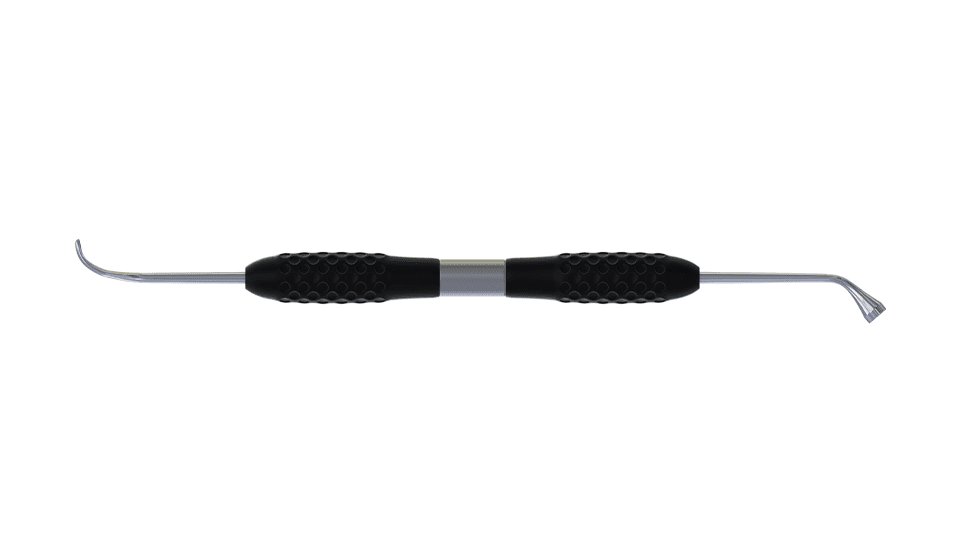
Double-sided autoclavable instrument: a spatula end (Ø5.8 mm) to grasp and deliver graft material, and a bone-pusher end (Ø5.0 mm) to condense the plug into the socket. Purpose-built for placing the Sponge plugs. One tool — reference SGTOOL, listed at $59 — is included free with every practice bundle, whichever graft material you choose.
Spatula end (Ø5.8 mm) grasps and places the plug
Bone-pusher end (Ø5.0 mm) condenses it into the socket
Stainless head you autoclave and reuse, no disposables
Made for the Sponge plugs, so you don’t improvise with a flat instrument
Clinical evidence
What the evidence supports, at three different levels
Evidence for the procedure is not evidence for a material class, and neither is evidence for a specific product. These are kept apart on purpose.
Evidence about grafting the site
Grafting an extraction site reduces ridge loss — it does not stop it
Alveolar bone resorbs predictably after extraction. A systematic review of human studies reported roughly 3.8 mm of horizontal width loss and about 1.2 mm of mid-buccal height loss at six months. A meta-analysis of ridge-preservation interventions found grafted sites lost roughly 1.3–1.5 mm less width and 0.9–1.1 mm less height than untreated ones, and that implants could be placed as planned without further augmentation at 90.1% of grafted sites against 79.2% of untreated ones. Resorption is reduced, not eliminated.
Both classes are osteoconductive — and neither is established as superior
β-tricalcium phosphate / hydroxyapatite blends and bovine bone mineral are both osteoconductive: they scaffold the patient’s own bone rather than forming bone themselves. The practical difference is turnover — the β-TCP fraction is the more soluble of the synthetic pair, while bovine bone mineral persists longer at the site. A systematic review and meta-analysis of nine ridge-preservation modalities concluded that whether there is a superior approach "could not be determined on the basis of the selected evidence". Treat the choice as case-by-case, not as a ranking.
What exists for these two DSI plugs, stated plainly
We are not aware of published randomised controlled trials on SpongeGraft or Sponge ZenGraft specifically. What exists is manufacturer-published clinical case documentation and evaluations from clinicians who use them — genuinely useful for seeing handling and technique, and not the same class of evidence as the reviews above. We would rather say that than let general ridge-preservation data stand in as a product claim.
The figures above describe published results for ridge preservation as a procedure and for material classes in general. They are not outcome claims for these products, and no clinical outcome is guaranteed. Boxes contain 5 plugs of the material described, and nothing on this page should be read as a promise of bone formation.
What clinicians say
Clinicians who place these plugs, in their own words
Evaluations of the DSI Sponge plugs published by the manufacturer. We supply the same product from Lakewood, NJ.
Prof. Ziv Mazor
I have been using DSI Sponge as a routine in my extraction site alone or combined with a biomaterial. Handling properties are excellent. I am very much satisfied with the results.
Clinical instructor and lecturer, periodontal department, Hadassah School of Dental Medicine, Jerusalem
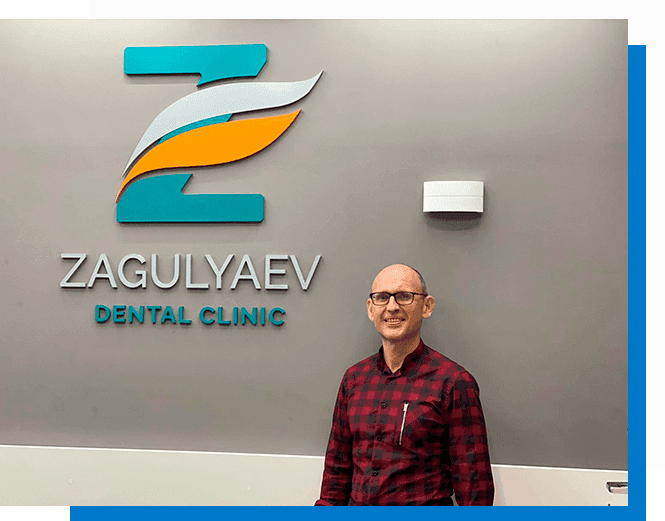
Dr. Zagulyaev Alexander
In our clinics, we use mostly compressive implants with an immediate loading technique, “same day teeth”. SpongeGraft is a core part of our clinical protocol for faster and more confident implant loading.
Implantologist, 30+ years of experience and 9,000+ implant restorations; founder of the Z-dent clinic network
Dr. Miroshnik Vladislav
DSI SpongeGraft is much more than a post-extraction socket solution. With sufficient surgeon’s skill, it becomes a valuable tool, useful in very compromised bone cases.
Local and international lecturer, 40+ years of clinical experience; honorary professor of dentistry
Before you order
Dental bone graft material questions, answered
What dental bone graft materials does Implanex offer?
Two, both supplied as preformed collagen graft plugs. SpongeGraft (DS-SG1020) is a synthetic alloplast — a 60% β-tricalcium phosphate / 40% hydroxyapatite mineral on a bovine Type I collagen carrier. Sponge ZenGraft (DS-ZG1020) is a xenograft — natural bovine bone mineral on the same collagen carrier. Both are 10 × 20 mm, 5 sterile plugs per box, and both are supplied to dental practices from Lakewood, New Jersey.
What is the difference between synthetic and bovine bone graft material?
The mineral phase and where it comes from. A synthetic alloplast is manufactured to mimic the mineral of bone — in this case a β-tricalcium phosphate and hydroxyapatite blend. A bovine xenograft is bone mineral of animal origin, processed to remove cellular elements and leave the mineral matrix. Both are osteoconductive scaffolds; the practical difference is how readily the mineral turns over, with the β-TCP fraction the more soluble and the bovine mineral persisting longer at the site.
What is β-TCP and hydroxyapatite?
Both are calcium phosphate ceramics used as synthetic bone graft materials. β-tricalcium phosphate is the more soluble of the pair and turns over sooner; hydroxyapatite is the less soluble and holds its volume longer. Blending them — here at 60% β-TCP to 40% hydroxyapatite — is a way of getting a balanced resorption profile rather than the behaviour of either extreme.
What is bovine xenograft material?
A xenograft is graft material sourced from a different species — in dentistry, almost always bovine. The bone is processed to remove cellular elements and leave the mineral matrix, then sterilised. The mineral in Sponge ZenGraft is DSI's ZenOss natural bovine bone mineral, a 20/80 cortical-cancellous matrix that is gamma-sterilised and contains no cellular elements.
Which graft material resorbs more slowly?
The bovine mineral. It persists longer at the graft site, which is why it is generally the one selected when longer-term space maintenance is the priority. The synthetic option is a balanced blend — the β-TCP fraction turns over sooner, the hydroxyapatite fraction more slowly. We do not publish resorption timelines for either: the rate depends on the site and the patient, and any figure quoted as a guarantee should be treated with suspicion.
Are the products supplied as particles or plugs?
As plugs. The mineral is carried inside a preformed Type I collagen sponge rather than supplied loose, so there is no particulate to mix, pack or protect against washout. That is a handling difference, not a biological one — the mineral phase inside is what determines the graft behaviour.
How many plugs come in each box?
5 plugs per box, for both the synthetic and the bovine product. Each plug is individually sealed in its own sterile double blister, and printed instructions for use are included in every box.
Do the graft plugs require mixing?
No. The plug is placed dry, straight out of the blister, into the bleeding site. There is no rehydration step, no chairside mixing and no loose particulate to pack.
What size are the graft plugs?
Both products are supplied as 10 × 20 mm plugs — a single size across the range. Whether to trim a plug or use more than one at a site is a clinical decision and should follow the instructions for use.
Are the plugs sterile?
Yes. Each plug is supplied sterile in its own individually sealed double blister, for single use. Open one blister per site.
What procedures are they intended for?
DSI lists extraction socket and ridge preservation, periodontal defects, defects around implants, post-resection and cystectomy defects, and crest maintenance ahead of implant placement. The instructions for use supplied in the box govern indications and contraindications — and not every extraction socket is an appropriate site for grafting.
Is a membrane always required?
In an intact, contained extraction socket the plug can be placed as a one-step procedure without a separate membrane. Where a socket wall is deficient or the defect is not contained, a barrier membrane and standard guided bone regeneration principles still apply. Treat "no membrane" as a description of the contained-socket case, not a general rule.
Are placement tools included?
Yes — one double-sided bone graft tool (SGTOOL), a $59 instrument, is included free with every practice bundle, whichever material you choose. It is double-ended and autoclavable: a spatula end (Ø5.8 mm) to grasp and deliver the plug, and a bone-pusher end (Ø5.0 mm) to condense it into the site.
How do practice bundles work?
Bundles are priced on the number of paid boxes, at list. Buy 5 and you also receive 1 free box and 1 free placement tool; buy 9 and you receive 2 free boxes and a tool; buy 13 and you receive 3 free boxes and a tool. Every purchased box is billed at list price — the bundle value is in the free boxes and the tool, not a per-box discount. Bundle pricing starts at 5 paid boxes; ask if you need a different quantity or a mix of both materials.
How quickly are orders shipped?
Orders ship next day from our Lakewood, New Jersey location, for delivery across the United States. For a specific lead time or a larger quantity, call or message us and you will get a direct answer.
How do I request written pricing?
Send the quote request on this page, or call or WhatsApp us. There is no online checkout and no account to create. We reply with a written price and lead times, you confirm by email, phone or WhatsApp, and the order ships. Your details go to our sales team only, and there is no rep visit unless you ask for one.
Compare dental bone graft materials for your practice
Review the synthetic and bovine graft-plug options, bundle quantities and practice pricing. Pick a material and a tier, leave your details, and we send a written price with lead times. No online checkout, and no rep visit unless you ask.
Written quote — no checkout
No rep visit unless you ask
Ships from Lakewood, NJ
Have a product question first?
Ask for Yossi Nisenbaum. Real answers on material selection, stock, lead times and larger orders — not a call centre.
Who you are buying from. Implanex® is an authorized distributor of DSI® dental bone grafting products, manufactured by DSI Ltd., Israel. We ship from 1095 Towbin Ave, Lakewood, NJ 08701. DSI is a trademark of its respective owner and we are not affiliated with any other manufacturer named on this page.
What happens next. Orders ship next day from Lakewood for delivery across the United States, and are supplied to licensed dental professionals and dental practices only. Prices shown exclude any applicable tax. Read our Terms of Service, Privacy Policy and Cookie Policy.