
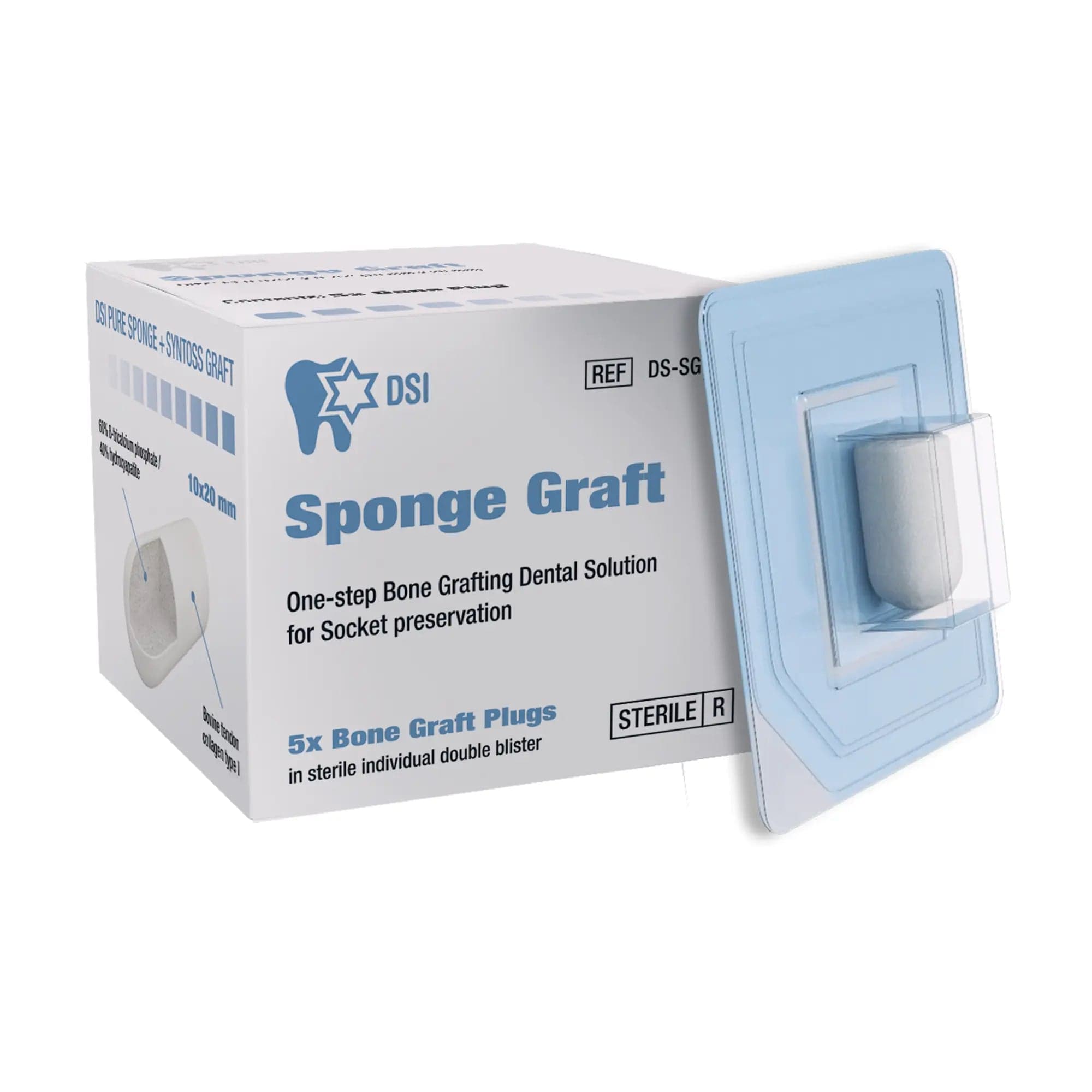
Synthetic mineral
SpongeGraft
Routine extraction sockets where a synthetic mineral phase is preferred.
For dental professionalsAuthorized DSI® distributor
Compare synthetic and bovine collagen graft plugs built for extraction-socket preservation. Sterile 5-plug boxes, placed dry in one step — no chairside mixing — supplied to US practices from Lakewood, New Jersey.
Written quotes, no online checkout. (908) 910-2290
Why a plug
Six things that are true of both products, and that particulate-plus-membrane grafting does not give you.
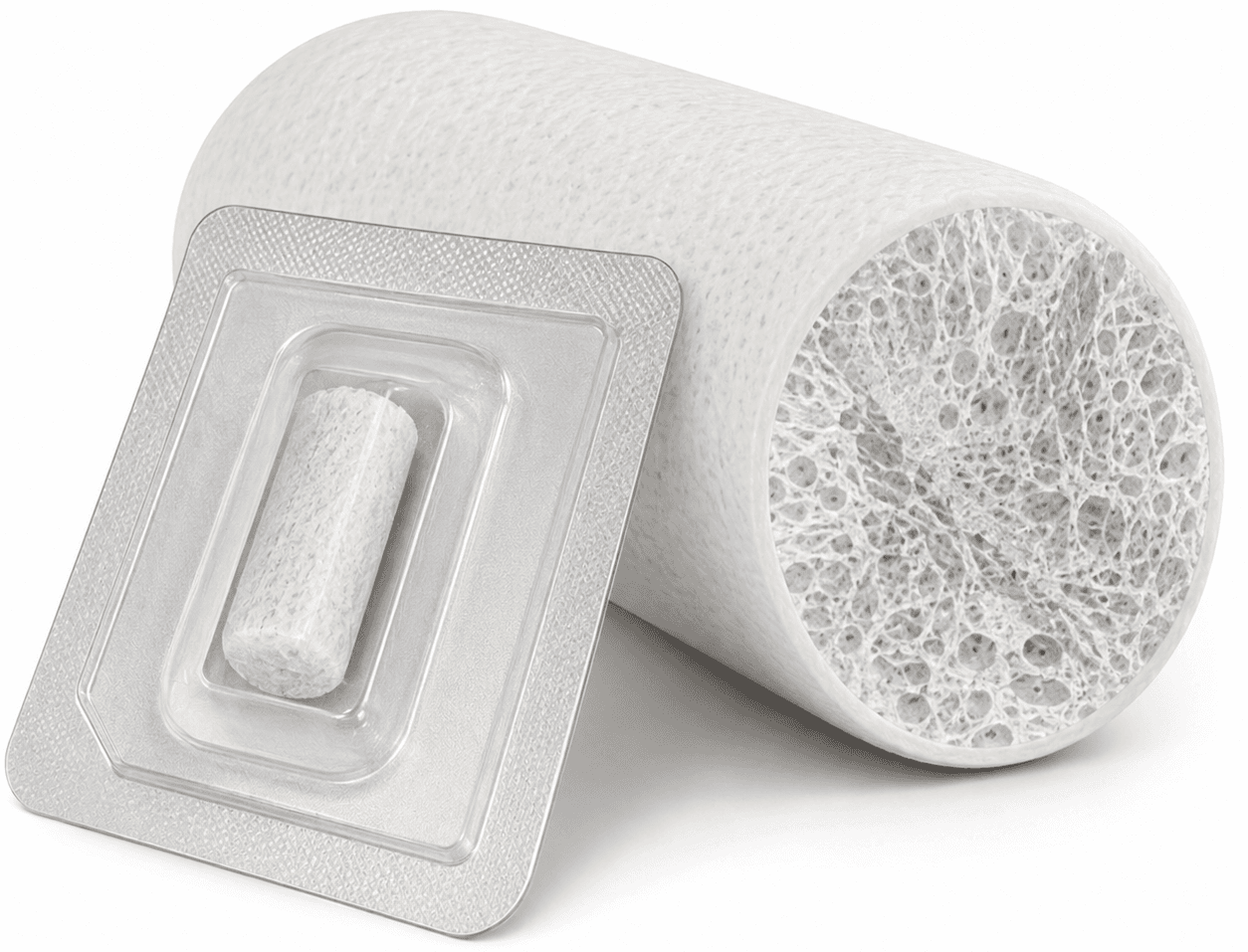
Open the sterile blister and place the plug dry into the bleeding socket. No rehydration, no chairside mixing, no particulate to pack.
The Type I collagen body adapts to the socket walls and holds the mineral in place through irrigation and closure, so the graft stays where you put it.
Collagen takes up blood on contact and stabilizes the clot as you place, so haemostasis and grafting happen in the same step.
Choose a synthetic β-TCP / hydroxyapatite mineral or a deproteinized bovine xenograft — same plug format, same placement, different resorption profile.
Each of the 5 plugs in a box is sealed in its own sterile double blister, with instructions for use included in every box.
Buy in bundles and every order includes a free double-sided bone graft tool — a $59 instrument built for these plugs.
The procedure
Socket preservation — also called ridge preservation or socket grafting — is the placement of a graft material into an extraction socket at the time of extraction, to limit the ridge remodelling that follows. It is a procedure, not a product: the clinical technique is yours, and the graft material is the part you choose and buy.
Alveolar bone resorbs predictably once a tooth is removed, and most of the change happens early. A systematic review of human studies reported roughly 3.8 mm of horizontal width loss and about 1.2 mm of mid-buccal height loss six months after extraction, with the fastest reduction in the first three to six months. Left unmanaged, a routine implant site can turn into an augmentation case.
Graft materials differ mainly in how quickly the mineral resorbs. A faster-resorbing synthetic phase turns over sooner as the patient’s own bone forms along it; a slow-resorbing xenograft persists longer as a space maintainer, which is generally favoured when long-term volume stability is the priority. Handling matters too — a carrier that holds the mineral in the socket removes the washout and packing problems of loose particulate.
The ideal indication is an atraumatic extraction where the socket walls are intact and the defect is contained. In intact, contained sockets these plugs are placed as a one-step procedure without a separate membrane. Where a wall is deficient or the defect is not contained, a barrier membrane and standard guided bone regeneration principles still apply — this product does not replace that judgement.
Dimensional-change figures: Tan WL, Wong TLT, Wong MCM, Lang NP. A systematic review of post-extractional alveolar hard and soft tissue dimensional changes in humans. Clin Oral Implants Res. 2012;23(Suppl 5):1–21. View on PubMed
Synthetic vs bovine
Same plug, same placement, same box count. The mineral inside the collagen is the whole difference — and it decides how quickly the graft turns over.
Routine extraction sockets where a synthetic mineral phase is preferred.
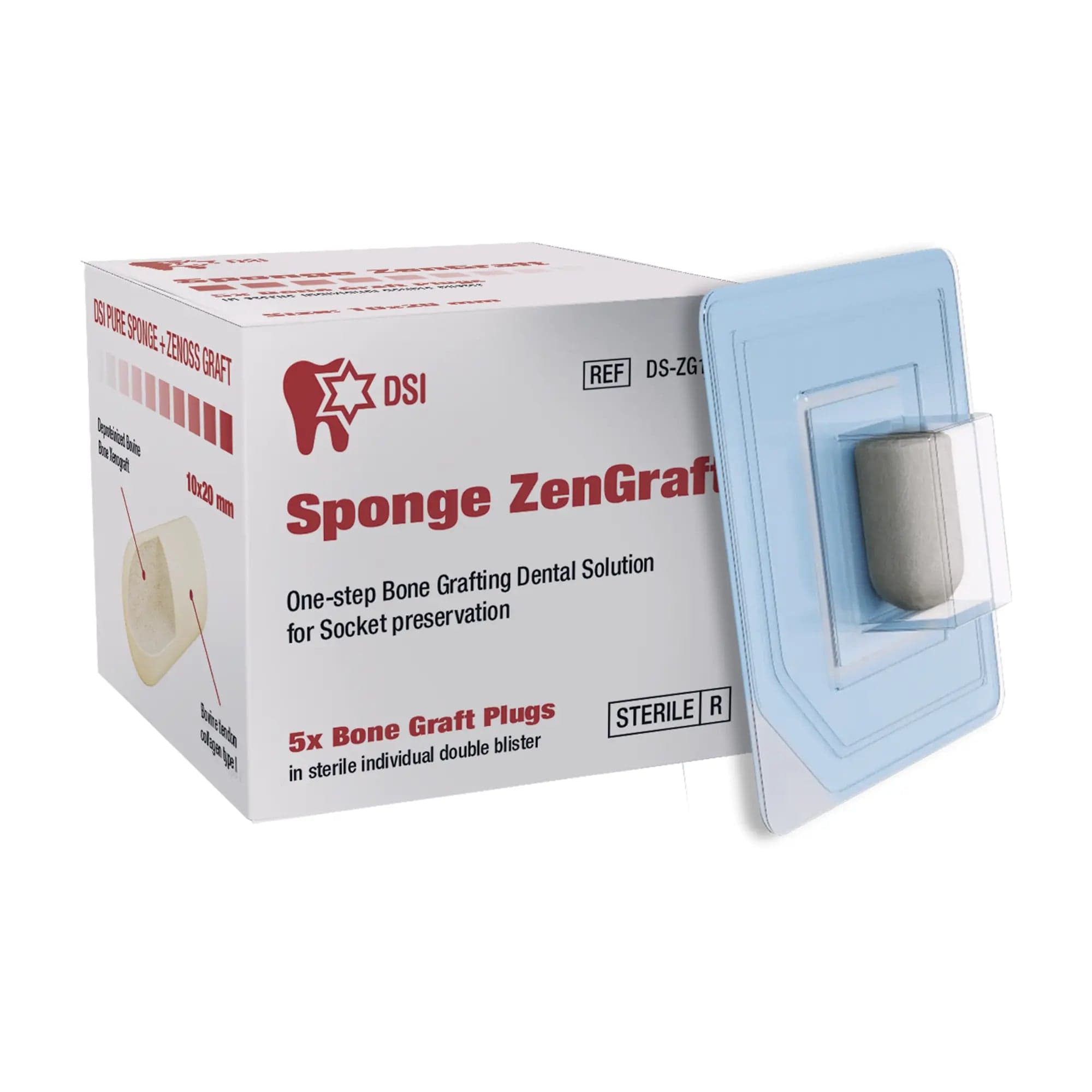
Cases that benefit from a natural xenograft and slow, long-term volume maintenance.
| Property | SpongeGraft· Synthetic mineral | Sponge ZenGraft· Bovine xenograft |
|---|---|---|
| Material classDiffers | SpongeGraftSynthetic mineral on a collagen carrier | Sponge ZenGraftBovine xenograft on a collagen carrier |
| Mineral phaseDiffers | SpongeGraft60% β-tricalcium phosphate / 40% hydroxyapatite | Sponge ZenGraftDeproteinized bovine bone mineral |
| Collagen carrier | SpongeGraftBovine tendon collagen Type I | Sponge ZenGraftBovine tendon collagen Type I |
| Resorption profileDiffers | SpongeGraftBalanced — the β-TCP fraction is more soluble, the hydroxyapatite slower | Sponge ZenGraftSlow — residual particles persist as space maintainers |
| Typical positioningDiffers | SpongeGraftRoutine extraction sockets where a synthetic mineral is preferred | Sponge ZenGraftCases where long-term ridge volume maintenance is the priority |
| Plug size | SpongeGraft10 × 20 mm | Sponge ZenGraft10 × 20 mm |
| Plugs per box | SpongeGraft5 | Sponge ZenGraft5 |
| Packaging | SpongeGraftSterile individual double blister | Sponge ZenGraftSterile individual double blister |
| Handling | SpongeGraftPlaced dry, one step — no rehydration or mixing | Sponge ZenGraftPlaced dry, one step — no rehydration or mixing |
| Reference | SpongeGraftDS-SG1020 | Sponge ZenGraftDS-ZG1020 |
| Price per boxDiffers | SpongeGraft$219 list | Sponge ZenGraft$289 list |
| Bundles & free tool | SpongeGraftYes — all three practice bundles | Sponge ZenGraftYes — all three practice bundles |
Still deciding? SpongeGraft is the routine choice for everyday sockets; Sponge ZenGraft is the one to reach for when long-term ridge volume is the priority. We quote either — or a mix — on the same bundle terms. For the full specification sheet and the category background, see dental bone graft materials.
Get practice pricingChairside workflow
Four steps, in the order they happen. The clinical technique is yours — this is only where the material goes.
Extract as atraumatically as the case allows, then debride and curette the socket to your normal protocol. Assess whether the walls are intact and the defect is contained before you choose the graft.
Pick the synthetic or bovine mineral for the case, and the plug count for the site. Plugs are supplied at 10 × 20 mm; sizing and trimming decisions are yours and should follow the instructions for use.
Open the sterile blister and deliver the plug dry into the bleeding socket. No rehydration or chairside mixing. The included placement tool has a spatula end to deliver the plug and a bone-pusher end to seat it.
Complete closure and suturing according to the case. In intact, contained sockets no separate membrane is needed; where walls are deficient, use a membrane and standard grafting principles as you would otherwise.
This is an overview of where the product fits in the visit, not a surgical protocol. Instructions for use are included in every box and govern handling, indications and contraindications.
Clinical-use considerations
The limits matter as much as the indications. Read this before you order.
Professional use. For use by licensed dental professionals only. This page is product information for a dental practice audience, not medical or clinical advice, and not a substitute for the manufacturer’s instructions for use — which are included in every box and take precedence. Always apply your own clinical judgement.
Practice bundles
Bundles are priced on paid boxes at list. The free boxes and the placement tool are what the bundle adds — pick your material, pick a tier, and we send a written quote.
Showing SpongeGraft Bone Plugs · REF DS-SG1020 · $219 per box of 5 plugs
Buy 5 · +1 box + 1 tool free
$1,095for 5 paid boxes
$183 effective per box · $36.50 per plug
$278 of product included free
Buy 9 · +2 boxes + 1 tool free
$1,971for 9 paid boxes
$179 effective per box · $35.84 per plug
$497 of product included free
Buy 13 · +3 boxes + 1 tool free
$2,847for 13 paid boxes
$178 effective per box · $35.59 per plug
$716 of product included free
Bundle pricing starts at 5 paid boxes — $1,095 synthetic or $1,445 bovine. Every purchased box is billed at the $219 list price; the free boxes and tool are what the bundle adds, so the “effective per box” figure above is total paid divided by total boxes received, not a discount. Prices exclude any applicable tax. Need a different quantity, or a mix of both materials? Ask and we’ll quote it.
Included with every bundle
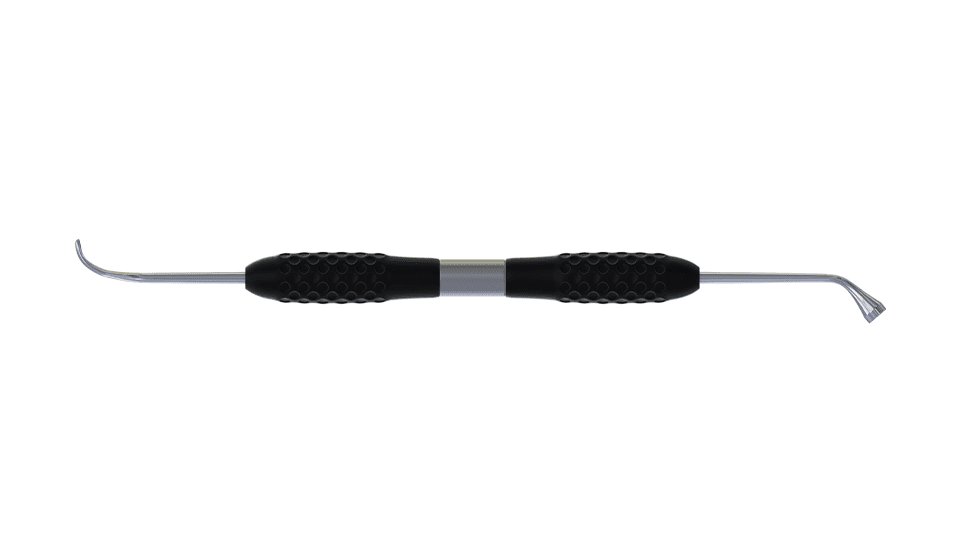
Double-sided autoclavable instrument: a spatula end (Ø5.8 mm) to grasp and deliver graft material, and a bone-pusher end (Ø5.0 mm) to condense the plug into the socket. Purpose-built for placing the Sponge plugs. One tool — reference SGTOOL, listed at $59 — is included free with every practice bundle, whichever graft material you choose.
Clinical evidence
Evidence for the procedure is not evidence for a material class, and neither is evidence for a specific product. These are kept apart on purpose.
Evidence about the procedure
A meta-analysis comparing ridge preservation with unassisted socket healing reported roughly 1.3–1.5 mm less bucco-oral width loss and 0.9–1.1 mm less height loss in grafted sites. In the same analysis, implants could be placed in the planned position without further augmentation at 90.1% of grafted sites, against 79.2% of untreated ones. A European Federation of Periodontology workshop consensus put the preventable reduction at roughly 1.5–2.4 mm horizontally and 1–2.5 mm at the mid-buccal. Resorption is reduced, not eliminated.
Evidence about the material classes
β-tricalcium phosphate / hydroxyapatite blends and deproteinized bovine bone mineral are both osteoconductive: they act as a scaffold along which the patient’s own bone forms, rather than forming bone themselves. The practical difference is resorption rate — the β-TCP fraction is the more soluble of the synthetic pair, while deproteinized bovine mineral resorbs slowly and residual particles persist as space maintainers. Reviews of socket-sealing and grafting materials have not established that any one material class is clinically superior for hard-tissue outcomes, so the choice is a case-by-case judgement, not a ranking.
Evidence about these specific products
We are not aware of published randomized controlled trials on these two DSI plugs specifically. What does exist is manufacturer-published clinical case documentation and evaluations from clinicians who use them — useful for seeing handling and technique, but not the same class of evidence as the studies above. We would rather say that than let general socket-preservation data stand in for a product claim.
Figures above describe published results for socket preservation as a procedure and for material classes in general. They are not outcome claims for 5-plug DSI SpongeGraft or Sponge ZenGraft boxes, and no clinical outcome is guaranteed.
What clinicians say
Evaluations of the DSI Sponge plugs published by the manufacturer. We supply the same product from Lakewood, NJ.

Prof. Ziv Mazor
I have been using DSI Sponge as a routine in my extraction site alone or combined with a biomaterial. Handling properties are excellent. I am very much satisfied with the results.
Clinical instructor and lecturer, periodontal department, Hadassah School of Dental Medicine, Jerusalem
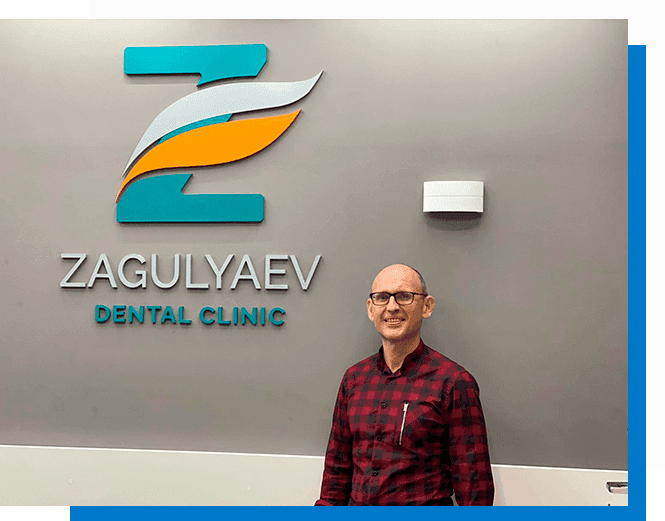
Dr. Zagulyaev Alexander
In our clinics, we use mostly compressive implants with an immediate loading technique, “same day teeth”. SpongeGraft is a core part of our clinical protocol for faster and more confident implant loading.
Implantologist, 30+ years of experience and 9,000+ implant restorations; founder of the Z-dent clinic network

Dr. Miroshnik Vladislav
DSI SpongeGraft is much more than a post-extraction socket solution. With sufficient surgeon’s skill, it becomes a valuable tool, useful in very compromised bone cases.
Local and international lecturer, 40+ years of clinical experience; honorary professor of dentistry
Before you order
A socket preservation bone graft is a graft material placed into an extraction socket at the time of extraction to limit the ridge remodelling that follows. Implanex supplies it in plug form: a Type I collagen sponge carrying a bone mineral, shaped to sit in the socket. The plug is the material — the socket preservation procedure itself is the clinician’s.
Only the mineral inside the collagen. SpongeGraft (DS-SG1020) carries a synthetic 60% β-tricalcium phosphate / 40% hydroxyapatite mineral with a balanced resorption profile. Sponge ZenGraft (DS-ZG1020) carries deproteinized bovine bone mineral, which resorbs slowly and is favoured when long-term ridge volume maintenance is the priority. Both use the same bovine Type I collagen carrier, the same 10 × 20 mm plug and the same placement.
5 plugs per box, each individually sealed in its own sterile double blister, with instructions for use included. That applies to both the synthetic and the bovine product.
No. The plug is placed dry, straight from the blister, into the bleeding socket. There is no chairside mixing, no rehydration step and no loose particulate to pack.
In an intact, contained extraction socket the plug can be placed as a one-step procedure without a separate membrane. Where a socket wall is deficient or the defect is not contained, a barrier membrane and standard guided bone regeneration principles still apply. Treat “no membrane” as a description of the contained-socket case, not a general rule.
Both products are supplied as 10 × 20 mm plugs. Sizing for a given socket, including whether to trim or use more than one plug, is a clinical decision and should follow the instructions for use.
Orders ship next day from our Lakewood, New Jersey location, for delivery across the United States. If you need a specific lead time or a larger quantity, call or message us and you will get a direct answer.
Bundles are priced on the number of paid boxes. Buy 5 and you also receive 1 free box and 1 free placement tool; buy 9 and you receive 2 free boxes and a tool; buy 13 and you receive 3 free boxes and a tool. Every purchased box is billed at list price — the bundle value is in the free boxes and the tool, not a per-box discount. Bundle pricing starts at 5 paid boxes; ask us if you need a different quantity.
Yes — one double-sided bone graft tool (SGTOOL), a $59 instrument, is included free with every bundle. It is double-ended and autoclavable: a spatula end to grasp and deliver the plug, and a bone-pusher end to condense it into the socket.
Send the quote request on this page, or call or WhatsApp us directly. There is no online checkout and no account to create. We reply with a written price and lead times, you confirm by email, phone or WhatsApp, and the order ships. Your details go to our sales team only, and there is no rep visit unless you ask for one.
Pick the material and the bundle, leave your details, and we’ll send a written price with lead times. No online checkout, and no rep visit unless you ask.
Prefer to talk it through?
Ask for Yossi Nisenbaum. Real answers on stock, lead times and larger orders — not a call centre.
Implanex® is an authorized distributor of DSI® dental bone grafting products, shipping from 1095 Towbin Ave, Lakewood, NJ 08701. Orders ship next day for delivery across the United States, and are supplied to licensed dental professionals and dental practices. DSI is a trademark of its respective owner.